Web1 let you read. Web2 let you post. Web3 lets you hold the keys. This page explains each stage in plain English — and why open rails matter for the next phase of the web.
Static sites and brochure pages. Companies published; visitors read. Little interaction, little personalization.
Publishers control content
Mostly one-way communication
Accounts were rare or simple
Era 02
Web2
Read + write
Social apps and platforms. Anyone can post — but the company owns the account, the feed rules, and the data.
User-generated content
Platforms control accounts
Your audience lives inside the app
Era 03
Web3
Read + write + own
Wallets and public blockchains. You can move assets and identity across apps without asking a single company for permission.
You hold the keys
Records sit on open ledgers
Apps plug into shared rails
Side-by-side
Lens
Web1
Web2
Web3
What you do
Read
Read and write
Read, write, and own
Who holds the account
Often no account
The platform
You (via a wallet)
Where value lives
Publisher sites
Inside closed apps
On shared public rails
Switching apps
Easy to leave a page
Hard — audience stays behind
Easier — assets and keys travel with you
Trust model
Trust the publisher
Trust the company
Verify on an open ledger
Benefits of Web3
These are structural benefits of open rails — not investment tips. Nothing here is financial advice. For entertainment and education only.
Self-custodyIf you hold the keys, you control the asset. No single company can freeze your wallet the way a platform can close an account.
PortabilityA wallet can talk to many apps. Your identity and assets are not locked inside one social network or store.
Open recordsPublic blockchains let anyone verify who sent what, when — without asking a private database for permission.
Programmable valueSmart contracts move assets when rules are met. That enables payments, tokenization, and automated settlement on shared rails.
Global accessAnyone with an internet connection can open a wallet. Borders matter less for basic digital ownership and transfer.
Composable appsBuilders can plug into the same rails. New products reuse wallets, tokens, and liquidity instead of rebuilding everything from scratch.
Note: some tokens can still be frozen by the company that issues them. Issuers of many stablecoins, such as Circle for USDC, can freeze their own tokens (Circle USDC terms, checked Oct 8, 2026).
The tokenization surge
Tokenization means recording real-world value — dollars, funds, stocks, commodities — as tokens on public blockchain rails. The idea is older than this cycle; what is new is that institutions, brokerages, and chains are shipping it in public, in real time.
Why it feels revolutionarySettlement, ownership, and transfer can ride shared rails instead of only closed databases. That is a structural shift in how assets move.
Why many expect it to keep growingOnce rails, custody, and regulation frameworks improve, more asset types can follow. Growth can look exponential early on an S-curve — still not a guarantee.
How Nodetrail Labs covers itWe explain what changed and why rails matter. We do not predict prices or tell you what to buy. Education and entertainment only.
Watch the caveatsLegal wrappers, custody, liquidity, and jurisdiction still matter. On-chain does not mean risk-free.
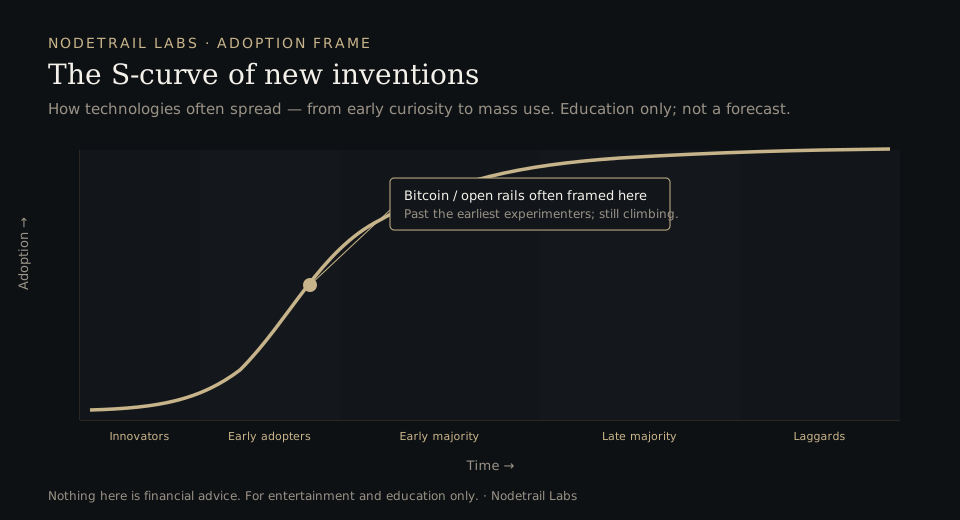
New inventions often follow an S-curve: slow start (innovators), steep climb (majority), then leveling off (laggards). Bitcoin and open blockchain rails are often discussed in that frame — useful for context, not a forecast of returns.
Classic Rogers-style adoption stages, after Everett M. Rogers, Diffusion of Innovations (1962). Educational framing only — not financial advice and not a price prediction.
Social trading growth
Social trading is when people watch, copy, or learn from others’ public positions and ideas — on X, Discord, on-chain dashboards, and copy-trading apps. Web3 makes more of that activity visible on open rails.
Why interest is risingMore wallets, cheaper chains, and live feeds of what traders and creators share. Beginners often start by following voices before they build their own process.
What “growth” can meanMore accounts, more copy tools, more on-chain mirrors of public strategies — not a guarantee any one trader or token wins. Trends can reverse.
How Nodetrail Labs frames itWe explain the trend and the rails. We do not give investment advice, signal lists, or “copy this wallet” recommendations. Entertainment and education only.
Watch the risksFollowing the crowd can amplify mistakes. Past performance is not a forecast. Never share seed phrases; verify links yourself.
How to read growth without mistaking it for advice
Look at participation Active wallets, creator followings, and app users — as context, not a buy signal.
Separate education from copying Learn the idea (DCA, hold, planned exits) instead of mirroring someone else’s size or timing.
Prefer transparent rails On-chain activity can be checked; closed-group “signals” often cannot.
What Web3 unlocks in practice
Digital cash and stablecoins Move value peer-to-peer on public chains, 24/7, with transparent settlement.
Tokenization Real-world assets (funds, stocks, commodities) can be recorded as tokens so ownership and transfer are programmable.
Self-custody wallets You keep the seed phrase. The trade-off: there is often no “forgot password” desk.
On-chain finance rails Lending, swaps, and settlement can run as open software — still with risk, fees, and learning curves.
Honest trade-offs
Owning the keys means you are responsible for them. Scams, phishing, and irreversible mistakes are real. Web3 does not remove risk — it changes who holds the control and who must stay careful.
Scammers exist in crypto; never share your seed phrase.